Pool heating can take several hours or much longer, depending on water volume, the temperature increase and the useful heat left after losses. There is no single heating time for every small pool. A calculation gives a useful starting point, but the heater’s actual output and the weather determine how closely the pool follows that estimate.
Start with the temperature increase you need
Subtract the current water temperature from the target temperature. Raising water from 20°C to 28°C requires an 8°C increase. Raising it from 26°C to 28°C requires only 2°C. The second task requires one quarter of the heat for the same volume, before accounting for losses.
This explains why the first warm-up after filling feels very different from daily temperature maintenance. A heater that maintains an already warm pool successfully may still need a long time to heat a cold fill.
Estimate the heat required by the water
Multiply the water volume in cubic meters by the temperature rise in degrees Celsius, then by 1.163. The result is approximately the required heat in kWh. For 10 cubic meters and an 8°C rise, that is about 93 kWh.
Next, divide by the heater’s average heat output in kW. If 10 kW reaches the water continuously and no heat escapes, the warm-up takes about 9.3 hours. This is an ideal estimate, not a promised heating time. Electricity consumption is a separate calculation and depends on the heater type and efficiency.

Subtract heat loss for a more realistic estimate
The heater adds heat while the pool loses it. Suppose, purely for illustration, the same heater supplies an average of 10 kW but average heat loss during the period is 2 kW. Only 8 kW remains to raise the water temperature. The 93 kWh requirement would then take about 11.6 hours.
If losses averaged 4 kW, the retained heating rate would fall to 6 kW and the estimate would become about 15.5 hours. These loss figures are examples, not standard allowances. Actual losses vary throughout the warm-up as temperatures and weather change.
Use actual output rather than electrical input
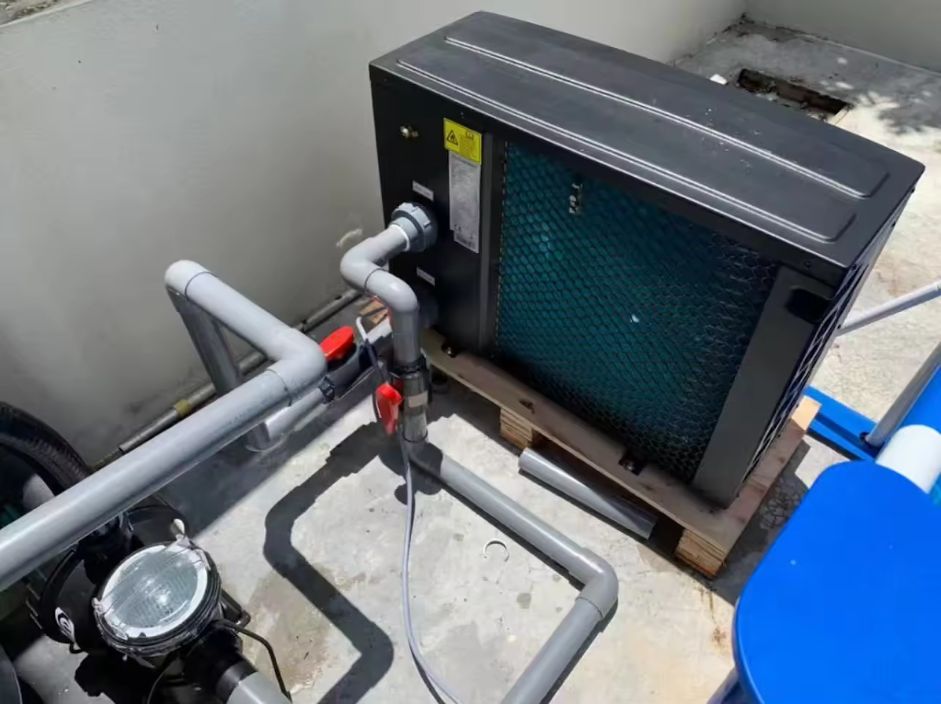
For a heat pump, a 10 kW heating-output figure does not mean it draws 10 kW of electricity. Its output can also change with air and water conditions. For a gas heater, a stated fuel-input rating must be adjusted for thermal efficiency to estimate heat reaching the water. [9]
If equipment information uses Btu per hour, convert to the same units before calculating. Approximately 3,412 Btu per hour equals 1 kW. Mixing an input rating with an output rating can produce a heating-time estimate that looks precise but is wrong.
A cover and operating schedule change the result
A suitable cover limits evaporation when the pool is unused, leaving more of the supplied heat available to warm the water. Wind, cool nights and exposed water can increase demand. Sunshine may add heat, so two otherwise similar days can produce different results. [11]

Equipment only heats while it is able and scheduled to run. A calculated 12 hours of active heating may take more than one day if the system operates for only 6 hours daily, especially when the water cools between sessions. Flow restrictions or equipment faults can also prevent the expected output; increasing the thermostat does not correct those problems.
Plan backward from when you want to swim
For an established pool, a record of starting temperature, weather, cover use and actual warm-up time gives a more useful schedule than a generic promise. For a new pool, specify how quickly it should be ready before choosing equipment.
Kaixin Pools can discuss pool volume and heating options as part of your project. Send your location, expected starting and target temperatures, and preferred readiness time so we can help define a practical equipment brief.